Henrique J. Santos

Neuroscience · University of Coimbra

HenriqueJ. Santos

SHANK3 is best known for its role at the synapse. My research examines its functions before the first synapse forms.

Doctoral researcher at the Center for Neuroscience and Cell Biology, University of Coimbra, working with human induced pluripotent stem cells and brain organoids.

Fig. 1A neuron, rendered in your browser. Drag to rotate.

Research

SHANK3, before the synapse

Scroll to follow SHANK3 from the synapse, where it is usually studied, to the nucleolus, where my work begins.

The established view

At the synapse

SHANK3 is one of the best-established autism genes, and its haploinsufficiency is considered the main cause of the neurological features of Phelan-McDermid syndrome.

Most of what is known about it comes from the synapse, where it scaffolds the postsynaptic density and anchors receptor complexes.

In Fig. 1, the berry points along the dendrites represent synapses.

My focus

In the nucleolus, before any synapse

My work looks earlier in development, in human induced pluripotent stem cells, neural progenitors and brain organoids. In these cells, SHANK3 is enriched in the nucleolus, where it regulates SOX2 expression and the pace of proliferation and differentiation.

SHANK3 insufficiency may therefore disturb development before a single synapse has formed.

Illustration. SHANK3 (red) concentrates in the nucleolus, ringed by nucleolin (green), inside a nucleus stained with Hoechst (blue).

Development

From stem cell to synapse

Four stages of neural development. Berry marks SHANK3 in the nucleolus of stem cells and progenitors, the focus of my work, and at the postsynaptic density, where it is usually studied.

  1. Stem cellSHANK3 is enriched in the nucleolus.

    My focus

  2. Neural progenitorSHANK3 regulates SOX2 expression and the pace of proliferation and differentiation.

    My focus

  3. Young neuronNeurites extend and seek their partners.
  4. SynapseSHANK3 scaffolds the postsynaptic density.

    The established view

In the lab

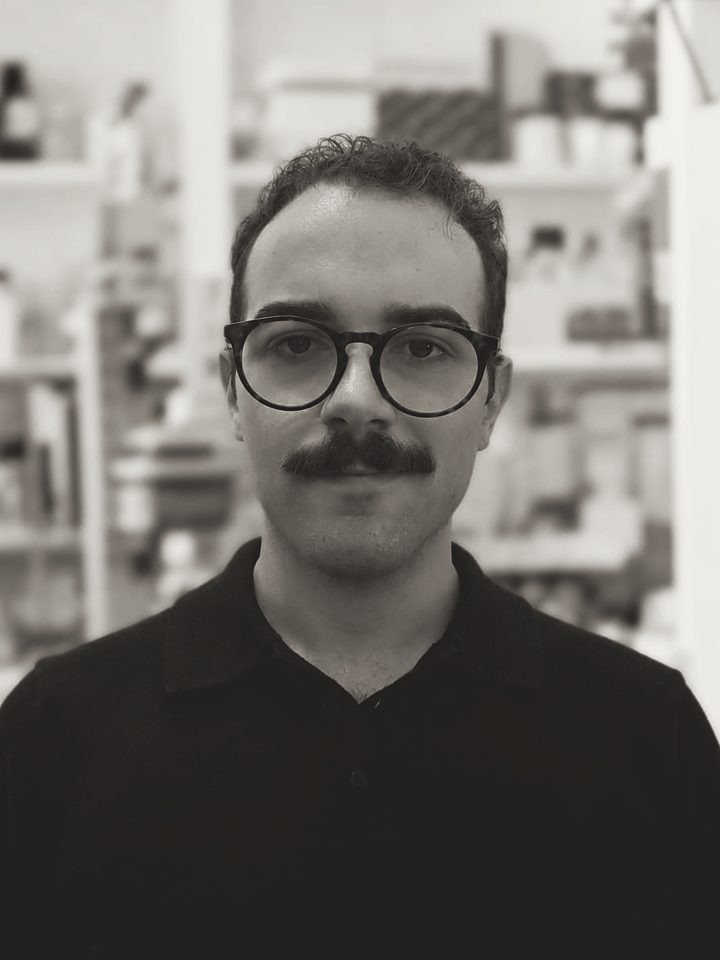
Henrique J. Santos in the laboratory
Fig. 2Henrique J. Santos in his natural habitat.
Group
Neuronal Circuits and Behavior group, led by João Peça, at CNC-UC and CIBB, University of Coimbra.
Funding
FCT doctoral fellowship. The project is supported by a 2024 Phelan-McDermid Syndrome Foundation Translational Award, whose application I co-wrote as a member of the team.
Recognition
Best Poster Awards at the ERA-NET NEURON Midterm Symposium (Berlin, May 2024) and the PMSF International Conference (Bloomington, July 2024).

Also exploring

Neuroscience and artificial intelligence

Alongside this work, I am interested in the interface between neuroscience and artificial intelligence, in particular whether memory consolidation inspired by sleep and the hippocampus can help language models retain new facts and combine facts learned separately.

Publications

Papers, thesis and posters

  1. 2026
    Oliveira AR, Cammarata G, Seabra C, Cardoso AM, Santos HJ, Guedes J, et al., Peça J
    Journal of Neurochemistry 170(2): e70388
    ContributionI contributed to the investigation and methodology.
  2. 2025
    Tomé D, Martins LF, Aroso M, Santos H, Costa RO, et al., Almeida RD
    iScience 28(9): 113401
    ContributionI generated the human cortical brain organoids.

Thesis

  1. 2023
    MSc thesis, University of Coimbra. Supervised by Ana Cardoso and João Peça.
    Full text under embargo until 2029.

Posters

  1. Best Poster Award
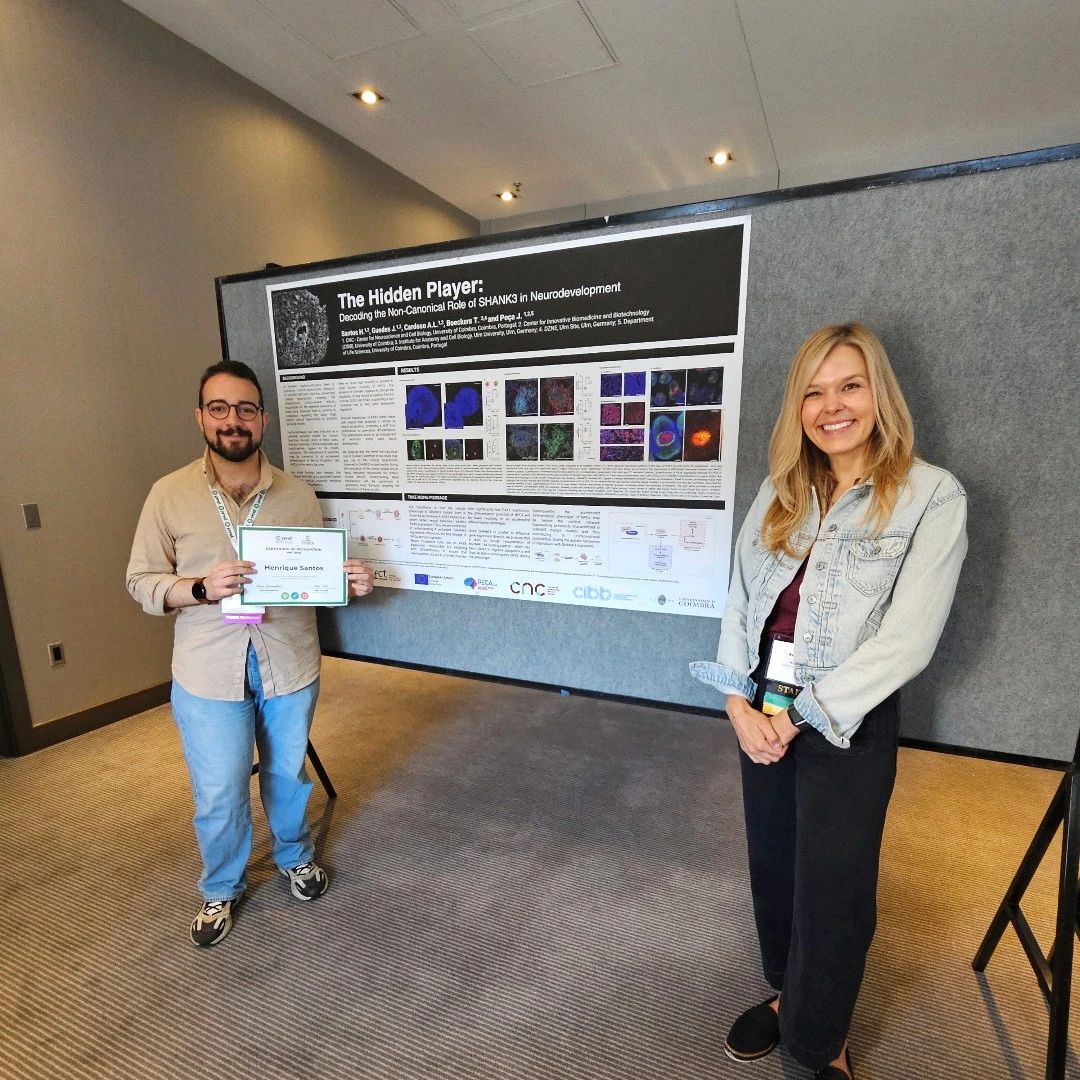
    The hidden player: decoding the non-canonical role of SHANK3 in neurodevelopment
    Phelan-McDermid Syndrome Foundation International Conference, Bloomington, Minnesota, July 2024
    Henrique J. Santos beside his poster at the Phelan-McDermid Syndrome Foundation International Conference in Bloomington, Minnesota, 2024
    Fig. 3Phelan-McDermid Syndrome Foundation International Conference.
  2. Best Poster Award
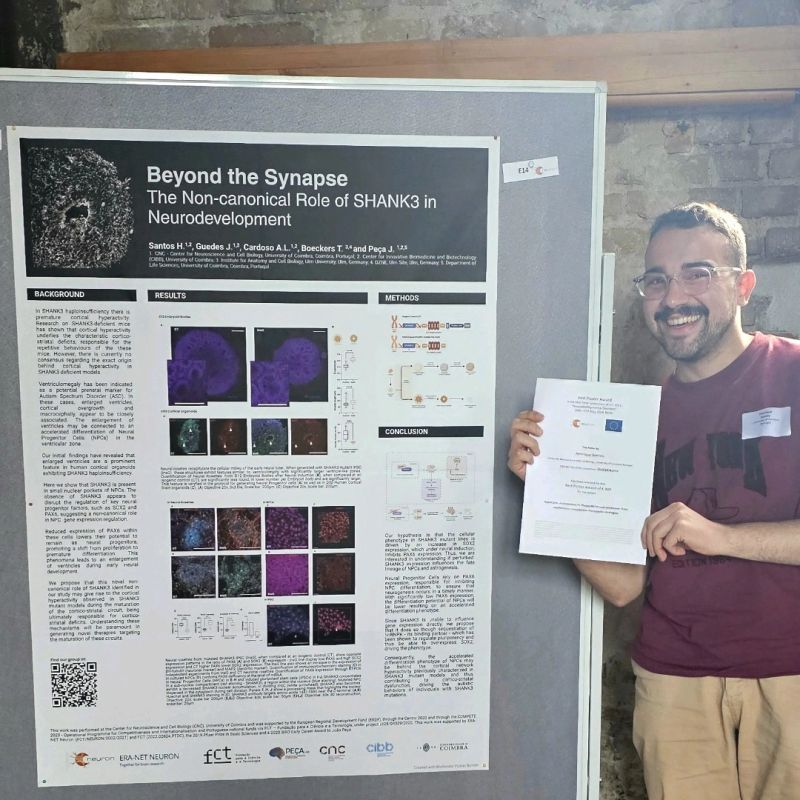
    Beyond the synapse: exploring the non-canonical role of SHANK3 in neurodevelopment
    ERA-NET NEURON Midterm Symposium, JTC 2021, Berlin, May 2024
    Henrique J. Santos beside his poster at the ERA-NET NEURON Midterm Symposium in Berlin, 2024
    Fig. 4ERA-NET NEURON Midterm Symposium.

Outreach

Era Uma Vez um Organoide

A Jornada de B3 · Once upon an organoid: B3's journey

In production

A documentary for a general audience about human brain organoids, following the journey of B3. I coordinate this ongoing project, which is funded by the University of Coimbra through its 2026 programme for the promotion of scientific culture (PCC).

After hours

Software I build

Outside the laboratory I write software, from tools for the bench to a revival of a chat client from 2009.

Laboratory software

Expression Factory

RT-qPCR, from plate to figure. Ct values you can check, and nothing hidden.

A desktop application for RT-qPCR, used in my laboratory. It covers the whole experiment: plate layout, pipetting and master-mix sheets, import of the instrument run, analysis and figures.

Its engine calls Ct values that match the instrument software to the last digit, and every excluded well or correction stays visible. It also designs primers, maintains the lab's shared primer library and tracks cell cultures from thaw to cDNA.

Status
In use in my lab, not yet public
Built with
Rust and React, during my PhD

Side project

reLive

Windows Live Messenger, running again.

In my spare time I am rebuilding Windows Live Messenger. My server implements the original MSNP protocol, and the web and Android clients preserve the glossy 2009 interface, with nudges, scenes, group chats, and voice and video calls.

Most of the work lies in reverse-engineering an undocumented protocol. Signing in and hearing that sound again never gets old.

Status
Online
Built with
Rust, on the open-source Escargot server
Visit
relivemsgr.com

Smaller projects are on GitHub.

Education

University of Coimbra

  1. 2024 to present
    PhD in Biosciences, Neurosciences
    FCT doctoral fellowship.
  2. 2021 to 2023
    MSc in Cellular and Molecular Biology, Neurobiology
    Final grade 18/20. Merit board, top 5% of students in 2022/23.
  3. 2021
    BSc in Biology, minor in Biochemistry

Contact

Get in touch

Email is the best way to reach me.

hsantos@cnc.uc.pt